
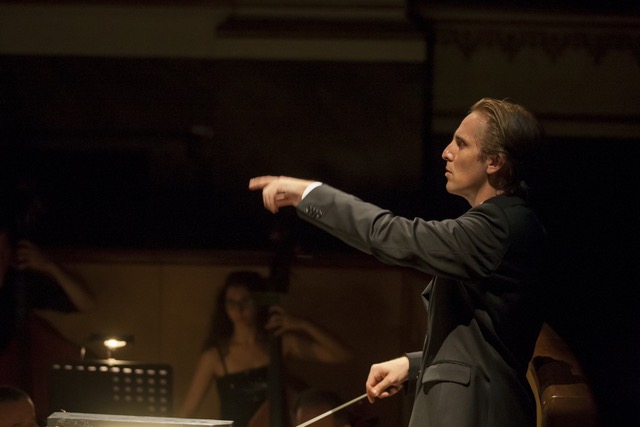
In 1982, Carmen, staged by René Terrasson, was performed in Chinese at the Central Opera House in Beijing by an entirely Chinese troupe. It was the first performance of a French opera in China, and the production was a triumph at its premiere on January 1. More than forty years after this historic event, Bizet’s masterpiece is returning to China—this time to Hong Kong. It will be conducted by Franck Chastrusse-Colombier, whom Première Loge met on this occasion.

Gisèle CHABOUDEZ – Hello Franck Chastrusse-Colombier, it’s a pleasure to hear you talk about your upcoming musical direction of Bizet’s opera Carmen at the French Festival in Hong Kong from May 7 to 10. You studied in Limoges, then conducting in Paris at the École Normale de Musique, then in Philadelphia and Siena, is that right ? Who were your masters and what do you remember as being most valuable in their teaching?
Franck CHASTRUSSE-COLOMBIER – Two individuals have particularly influenced me. The first is Maurizio Arena, whose humility and artistic integrity I remember most. Humility in the face of the masterpieces for which we bear the interpretive responsibility, and integrity in reading a score.There was also the invaluable advice of Georges Prêtre. I learned from him the inherent urgency of conducting.
G.C. – Your early career as a conductor was marked by your nomination to several competitions and your first performance conducting Rigoletto at the age of 22. Your career in opera has taken you to the Paris Symphony Orchestra, numerous conducting engagements, and then five years in Poland, where you conducted many works and took over as director of the Silesian Opera. What has been essential in your career so far, in France and Poland?
F.C.C. – A conductor’s career is a complex journey that isn’t simply defined by the accumulation of operatic productions. France is actually the country where I’ve conducted the least. In Poland, theaters operate as companies, and I’ve sometimes found myself conducting three different works in three days. Every stage of my career has allowed me to evolve in different contexts and scales. Long-term engagement with operatic works allows for a deeper understanding of the art form than time and study alone can provide.
G.C. – You conducted Luisa Miller in Avignon in 2024, which was very well received. I believe you offered a personal interpretation, different from the many previous ones?
F.C.C. – I come back to the issue of integrity. I haven’t done anything exceptional; I’ve simply tried to understand Maestro Verdi’s intentions through the few copies of the scores we have and his correspondence.In my opinion, this preparatory work is essential if one wants to go beyond the notes written on a score.
G.C. – So now you’re tackling Carmen in Hong Kong, a work you’ve conducted before and are familiar with. How are you approaching it this time ? How do the cast, staging, and physical conditions in which the performances are given influence the way you conduct a work?
F.C.C. – Opera is a complex art form based, in particular, on the interplay between what happens on stage and in the pit. The factors are therefore numerous, depending on the artists you collaborate with (their voices, their personalities, etc.). Staging and directing also influence the musical interpretation, as do the lighting.
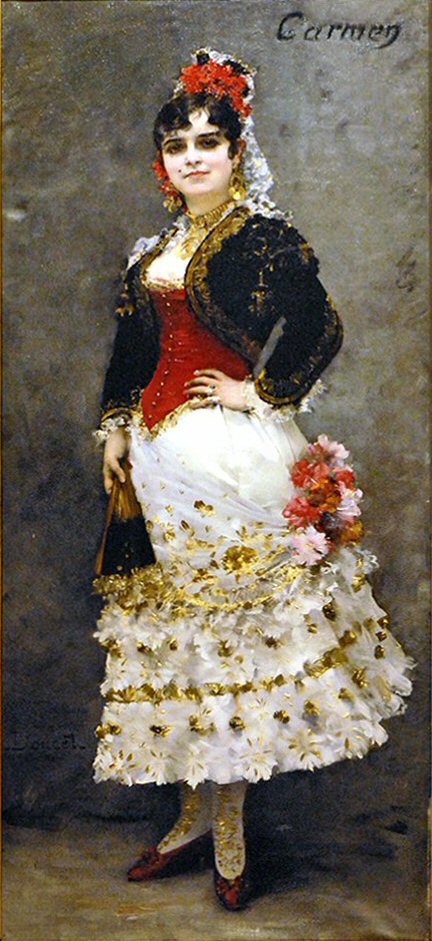
G.C. – What do you expect from a performer of Carmen? You knew one of the greatest, Béatrice Uria-Monzon, who passed away last year and who left her mark on this role. This time, you will have two Carmens alternating, Ambroisine Bré and Marie Gautrot…
F.C.C. – The relationship between a singer and a conductor can be one of the most beautiful forms of artistic collaboration. It is, in fact, the relationship of an entire orchestra (and sometimes the chorus) with the singers through the conductor.The conductor must allow the artists to give their best vocally, and also ensure a reading that maintains dramatic tension throughout the work.
G.C. – Hong Kong production benefit from having two actors for almost every role. Does this pose any particular problems for the conductor?
F.C.C. – Having a double cast is, above all, a privilege. For the Hong Kong production, we will have Marie Gautrot and Ambroisine Bré in the role of Carmen, Amadi Lagha and Sébastien Guèze as Don José, Timothée Varon as Escamillo, and finally Camille Schnoor and Perrine Madoeuf as Micaela. A double cast of Carmen with more French singers than on some of our national stages.
The musical challenge remains adapting from one evening to the next to the cast you have on stage. It’s a bit like in ballet where the title roles change almost every night.
G.C. – What does it mean to you to perform a masterpiece of the French opera repertoire in a country where opera is still certainly a rather unusual, not to say exotic, art form?
F.C.C. – The Chinese are familiar with a certain form of opera that dates back to the 12th century in their culture and which has since evolved into several forms. This production of Carmen will be directed by Jia Ding, who has chosen to set it in Hong Kong in 1978. I like this idea, because we are addressing a Hong Kong audience, and transposing Carmen into their culture is undoubtedly one of the best ways to allow them to connect with the drama. Bringing together Chinese and French artists to stage a new production of Carmen in Hong Kong is also a form of universalism. It is also an honor to bring French music beyond our borders.
———————————————————–
Watch interviews with several artists from this production:
– Marie Gautrot
– Perrine Madoeuf
– Timothée Varon
Pour lire cette interview en français, cliquez sur le drapeau !