OLIVER MEARS: “ It’s good to provoke different opinions ”
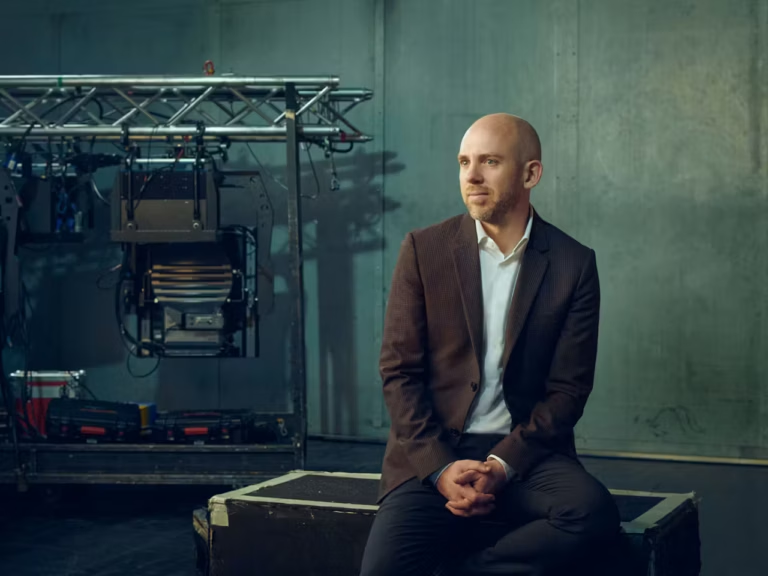
Before becoming Director of the Royal Opera, Covent Garden, Oliver Mears had already established himself as a brilliant opera director, whom Parisian audiences discovered with Semele. On the eve of the premiere of his new production at the Théâtre des Champs-Élysées, he welcomed us to discuss Manon Lescaut, his responsibilities as an opera house director, and his love of opera.
Hugues RAMEAU : You are currently working on Manon Lescaut at the Théâtre des Champs-Élysées. How did this co-production come about?
Oliver MEARS: It was a project I wanted to do at Covent Garden anyway, and then it turned out that the Théâtre des Champs-Élysées also wanted to stage it. We had enjoyed working together on Handel’s Semele, which was such a success, so it felt like a natural continuation of that collaboration. Opéra de Nice subsequently joined us.
It’s an opera I’ve wanted to do for a long time, and Baptiste Charroing was interested in it too, particularly because it hadn’t been staged in Paris for many years. Given how much of the story takes place in Paris, it feels wonderful to be making it here.
H.R.: Your production draws a parallel between Manon and Virginia Woolf’s Orlando. What interests you about that connection?
O.M.: I was interested in the idea of Manon as an archetypal character who has existed in many different forms across the centuries: in the original book, in ballet, in more than one opera, in stage productions and in films.
She reinvents herself according to the situation she finds herself in and the pressures she feels, particularly from the men in her life. That immediately got me thinking about Orlando, and the idea that she might be travelling not only through space but also through time.
Her identity shifts and changes, like a chameleon, but there is also something fundamental inside her. In the original Abbé Prévost novel, she is described as an “eternal dream”, and that idea is present in the opera too. But what is an eternal dream? Is it an eternal fantasy that men have about a woman like her? An eternal nightmare that she experiences because of everything she goes through? Or an eternal fairy tale?
Puccini describes a woman who is both very desirable and very vulnerable. Her predicament also speaks to the experience of women across the centuries.
H.R.: Will your Manon change gender, as Orlando does?
O.M.: You’ll have to wait and see! Maybe, maybe not, but there might be some suggestions.
H.R.: Manon is a character whose true nature remains elusive. Is that part of her fascination?
O.M.: Absolutely. In that way, she is a little like Don Giovanni: someone onto whom everyone can project what they think. There aren’t many moments when Manon reveals what she really wants. In a way, she is whoever you want her to be.
De Grieux is particularly interesting. He is a passionate, needy, almost Werther-like character who puts Manon on a pedestal. He sees her as an angel, a goddess, the most perfect woman imaginable. But Puccini famously described her as simply a nice girl with a big heart.
De Grieux’s tragedy is that he is determined to believe Manon is something she isn’t. Her tragedy is that she is constantly being forced to become something she is not, or is not comfortable being.
H.R.: You studied English and history. Did you discover Abbé Prévost’s novel early on?
O.M.: I read it much later, but it’s a wonderful book. I’ve always been fascinated by the treatment of sexuality in French literature: Les Liaisons dangereuses, Flaubert, Zola and Maupassant, particularly Zola’s depiction of Nana and the fascination with the femme fatale at the end of the nineteenth century.
There is this recurring figure of a woman who attracts men through her charisma, beauty and fire. You find her in La Traviata, La Bohème, Zola’s novels and even Henry James. There seems to be a natural connection between this beautiful, charismatic woman, with her erotic energy, and the world of Paris.
H.R.: You are working with French national treasure Roberto Alagna for the first time. How has that been?
O.M.: He’s wonderful because he knows the role inside out. He brings an extraordinary level of artistry, experience and passion to everything he does. As a stage director, it’s a pleasure to work with someone who feels so strongly about the music and its meaning, and wants to express that meaning on stage. That’s why he has been such a major figure in French musical life.
It’s also a pleasure for him to revisit the role after a long gap. It’s one of the most difficult roles in the Italian repertoire: it demands tremendous stamina and the ability to project over a very large orchestra. It’s a big challenge, but he sounds in great voice, and I’m sure it’s one he’ll relish.
H.R.: What has your experience been like at the Théâtre des Champs-Élysées?
O.M.: It’s a wonderful house. The people are very friendly and warm. It’s a smaller team than at some other opera houses, but the standards are incredibly high, and the history of the building is extraordinary.
We are very conscious of that history. There’s even a small reference to The Rite of Spring in our production, so audiences can look out for it.
H.R.: Your production of Semele also challenged conventional interpretations. How did audiences respond in Paris and London?
O.M.: I think the response was probably much the same in both cities. Some people liked it, others didn’t, and that’s fine. It’s good to provoke different opinions when you try to get to the essence of a piece and bring it to life for a modern audience rather than take a literal approach.
What I was proud of was how engaged the audience felt. That’s all I want as a director: for people to be gripped by opera, to experience it as a theatrical event and not just a musical one. My impression was that people were moved, and perhaps shocked, by the ending.
Sometimes people forget that Semele is the story of a man who seduces someone much less powerful than himself and incinerates her. That is the essence of the story. Yet the opera is often presented as something light and frothy, almost a comedy.
Of course, it has comic moments, but it is a very serious work. Jupiter is a serial philanderer, and his treatment of men and women is deeply unsentimental. We wanted to convey that. We were trying to get to the heart of the piece.
H.R.: You are both an opera director and the Director of the Royal Opera in London. Why is it important for you to continue directing?
O.M.: Working as a practitioner and being in the rehearsal room is incredibly exciting for me. It puts air in my tyres and motivates me to make really good work, both in my own productions and more widely within the building.
When you make theatre in the theatre you work in, you understand what it is like to stage something alongside your colleagues. That helps you understand what other directors experience when they come into your theatre. You can also model the passion, dedication, conscientiousness and work ethic that go into making a production.
It’s a great honour and privilege to do both. Each role feeds the other and helps me understand it better, even if it means dealing with a lot of emails when I get home after rehearsal.
H.R.: How do you decide on the repertoire at Covent Garden?
O.M.: It’s very much a conversation. Our music director, Jakub Hrůša, has projects he is passionate about, and he wants to explore more Czech repertoire in the coming years. Peter Katona (Director of Casting), who has been at Covent Garden for many years, helps us understand which roles the leading singers want to take on next.
Then there are the areas I want to focus on. We’ve given particular attention to our house composers, especially Benjamin Britten and Handel, who wrote so many operas and oratorios for the original Covent Garden theatre. We’ve also presented a Janáček cycle and commissioned our new Ring cycle with Barry Kosky and Antonio Pappano.
There are also masterpieces that haven’t been staged in London for decades. I Puritani and La Gioconda, for example, hadn’t been performed here for thirty years. It’s wonderful to bring these works back to the public. There are many different factors involved in deciding the repertoire.
H.R.: Has Brexit made international artistic collaboration more difficult?
O.M.: There is much more paperwork for everyone. When artists come to work at Covent Garden, there is paperwork for us and for them. But I think it’s even worse for British freelance artists working abroad. The forms and tax documents seem endless.
There is also the economic aspect, which is harder to quantify. Brexit has made everyone a bit poorer.
I would certainly be in favour of closer ties with Europe. When you can travel between London and Paris by train in two hours and twenty minutes, it feels as though we should be as close as possible.
H.R.: You founded Northern Ireland’s first national opera company. What did that experience teach you?
O.M.: There wasn’t much money, but there was fantastic energy and a real determination to make something as good as it could possibly be with limited resources. Sometimes, when you don’t have much money, it becomes a spur to the imagination. We were resourceful in our partnerships, working with the Ulster Orchestra and the Grand Opera House in Belfast.
It was also fascinating to engage with the culture, society and history of Northern Ireland. We wanted our productions to reflect aspects of that culture. We staged the first homegrown Wagner production there, Der fliegende Holländer, which felt particularly appropriate given the maritime heritage and the importance of the linen trade. Salome, meanwhile, had a particular resonance in a society where religion and fundamentalism play such a strong role.
My wife and I had very young children at the time. Northern Ireland is a beautiful place to bring up a family, with its wonderful coastline, nature, food and, above all, warm and friendly people. Despite its tragic and fascinating history, I have very fond memories of the place.
H.R.: You began as a theatre director rather than an opera director. How did that transition happen?
O.M.: I started directing plays at university and was fortunate to work with the playwright Howard Barker, whose work was widely translated into French. I also assisted Richard Jones, a brilliant British director from whom I learned a great deal.
At the same time, I began setting up my own opera company with a producer and a conductor in London. Somehow, I moved very quickly from theatre into opera and never really looked back. It would be nice to do both, but you tend to become typecast as an opera director.
I had listened to opera as a teenager, particularly Shostakovich’s Lady Macbeth of Mtsensk and Don Giovanni, but I didn’t see my first staged opera until I was twenty-one. It was at Covent Garden, and I realised that this was what I really wanted to do.
Opera brings together so many art forms. The music itself is inspiring, and if you love both music and theatre, opera is the logical place to be.
H.R.: What are the main differences between directing singers and actors?
O.M.: There are significant practical differences. Opera singers have to look after their voices, make sure they can be heard above the orchestra and manage their stamina. You cannot rehearse a Puccini or Verdi opera for as long as you might rehearse a play.
For Tosca at Covent Garden, for example, we had just three weeks in the studio, working with two different Toscas. That would be unheard of for a new play, which would have at least twice as much rehearsal time.
You therefore need to know what you want when you enter the rehearsal room. Actors often enjoy improvising, experimenting and trying things out. Singers tend to prefer structure. They want to know what the director wants so they can express themselves within that framework, musically as well as dramatically.
H.R.: How far in advance did you develop the concept for Manon Lescaut?
O.M.: My creative team and I developed the concept in the summer of 2025, when we did the concentrated work and designed the production. After that, you have to establish whether it is practical, affordable and workable in the theatre. Changes are always necessary, but the essence of the concept remains very much as we originally conceived it.
The rehearsal period itself consists of four weeks in the studio, including one week with the chorus, followed by two weeks on stage.
H.R.: You often work with the same designers. Is that important to you?
O.M.: I work with different people and different teams, but I’ve worked with Annemarie Woods for many years. We first worked together on Albert Herring at Aldeburgh in 2011. She is the costume designer and co-set designer on Manon Lescaut, alongside Ricardo Pardo.
When you know someone well, you develop a shared language and vocabulary, which makes the process quicker. Your tastes complement each other, and you can be completely honest: you can say that something doesn’t work, or that it’s fantastic. That honesty is important when you’re trying to make the right choices.
H.R.: You have directed four Britten operas. Is he your favourite composer?
O.M.: I wouldn’t say he is my favourite, because I have many favourite composers. But I do love Britten. There is something intrinsically dramatic about his operas.
The Rape of Lucretia is a fantastic work. Perhaps the title puts people off, which is a pity, because it is such a powerful opera. I directed it with Annemarie Woods at Aldeburgh four years ago, and the atmosphere and landscape made it a wonderful experience.
H.R.: What are your next productions?
O.M.: My next production at Covent Garden is La Gioconda, which I originally staged for the Salzburg Easter Festival. It’s the same production, rather than a completely new one. I’m also directing a new Verdi production in Italy, although I can’t reveal the details yet.
And then there’s Handel. He is definitely one of my favourite composers. I love the da capo aria, and I don’t think you should be too reverential about these works. Yes, I do make cuts.
At Covent Garden, we have concentrated on the Handel operas that received their premieres there: Semele, Alcina, Ariodante, Theodora and Berenice. The next phase will explore operas that have never been staged at the house. There are several Handel masterpieces still waiting to be discovered there.
H.R.: How is Covent Garden doing at the moment, and what lies ahead?
O.M.: We’re going through a really positive period. Audiences seem to have returned to where they needed to be after Covid, the theatre is full, people are happy, and I think the productions are strong.
My contract runs until 2032, which will be the theatre’s 300th anniversary. We’re already thinking about it, and it’s exciting.
H.R.: Some scoops?
O.M.: (laughs) No, nothing has been announced yet, but I think it’s going to be a great year in which we really celebrate the house’s long history.
Interview conducted on October 15, 2026
Consultez ci-dessous les catégories de notre rubrique « Interviews Première Loge » puis cliquez sur les images pour acéder aux entretiens qui vous intéressent…


- Si vous souhaitez publier un commentaire (dans l’encadré ci-dessous, en bas de page), merci de prendre connaissance auparavant de la « Charte des commentaires » ! / If you wish to post a comment (in the box below, at the bottom of the page), please read the “Comment Policy” first!